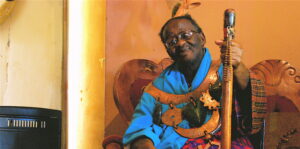
Princess Marimba
Her name was Marimba.
She was a princess, a daughter of the ancient African world, and her story comes from Credo Mutwa’s Indaba My Children, a book that holds the cosmological memory of the Zulu people. In that story, Princess Marimba looked at the tools of war surrounding her people and asked what they could become. From her hands came the berimbau, the drum, the marimba and others. The tools of war became the instruments of healing. Sound became the medicine.
I was living in a tipi in the Maluti Mountains of South Africa’s Free State when I first heard that story. I was deep inside my own relationship with African spirituality, feeling my way along a path that had begun on Table Mountain with a PVC didgeridoo and a tree, and had passed through the death of Paul Henderson and the gift of his instruments. The story of Princess Marimba was alive in me.
I decided to build a structure in her honour.
A round room. A ceremonial space. A place built for sound, for drumming, music, singing for the kind of gathering the princess herself had gathered, people around instruments where we could create music around the fire. I would call it Marimba House.
I had no money or any steady income. I had no title to the land. What I had was a borrowed chainsaw, a Volkswagen Kombi, a poplar forest on the mountain, and a desire to create a beautiful earthy structure.

Rustlers Valley, Maluti Mountains, Free State
I chose the site for the view it offered and the water source nearby.
Below the chosen site, in the rocks of the mountainside, we had found a small spring. Pure water rising straight from the mountain, cold and clear, enough for a small group of people living and gathering in that place. We built there. The spring would supply Marimba House for all the years of its life, rising from the rock directly beneath the floor on which ceremony would be held. It was a lot of work to get it flowing again after many decades of inactivity but it finally started to supply us with a trickle of 50 to 100 litres a day. It was enough.

The circular window, north-east aspect
The first big job was to gather enough thatch. The mountain grasses I needed for a roof were growing on the verges of the farm roads, that unclaimed strip between the road and the farmers’ fields where the grass grew long and uncut. I started a small thatch business. Each day I drove the women from the local village out to those road verges, and they spent the day cutting grass, paid per bundle. The more they cut the better the pay. I kept half the bundles for Marimba House and sold the other half to local farmers at double what I had paid. The surplus funded the labour. Ten or twelve people employed, the work sustaining itself from within. I needed ten to twelve thousand bundles to complete the roof. Each woman could cut thirty to fifty bundles in a day. The cutting went on for months.
The poles I cut myself from the poplar forest, trees that had spread through the valley over decades, pale and straight and useful. I loaded them into the Kombi and drove them up the steep kilometre of driveway to the site, trip by trip, the engine working hard on the gradient.
The walls went up with help. Enthusiastic, willing hands from the village, people who came and mixed and pasted and shaped. Black forest soil and cow dung combined and pressed onto the wattle frame. The African way, so that the walls can breathe. No concrete anywhere in the structure. No metal frames. The walls were alive, made of material that absorbed moisture and released it, that took the sound in and held it differently to any hard surface. The floor was the same mixture, soft underfoot, warm, conductive. A body lying on it during ceremony would feel the bass drum rising through the earth, coming from below as well as through the air.
For windows we went to the local motor scrapyard. They were happy to give away old car windows, glass sitting in a yard going nowhere. We pushed them directly into the wet mud walls, fixed with nails, mudded into place without frames.

The A-frame extending from the circular room, Maluti Mountains behind

Aerial view of the compound
The roof went on last. Mountain thatch grass, bundle by bundle, laid over a frame of poplar poles from the eaves to the smoke hole at the centre. That opening at the top was left deliberately. Through it the fire breathed and the smoke rose. A connection between the ground and the sky above.
The round form was the whole point. Sound moves in waves, and a round room holds waves the way a bowl holds water. I had felt this in ceremony. I could feel it in the drone of the didgeridoo moving through a space and returning changed. The room was designed around that knowledge, mud walls curving inward, thatch angling down, earth floor receiving, smoke hole open to release smoke and prayers into the environment.
Around the ceremonial room we built a small kitchen, and an A-frame structure facing the valley, and a cluster of small huts to accommodate guests. Marimba House was a complete small world, self-contained with its own garden, water supplied by the spring, sheltered by the mountain, oriented toward the spectacular valley below.
It took a few years to complete.
When it was almost finished, Credo Mutwa visited.
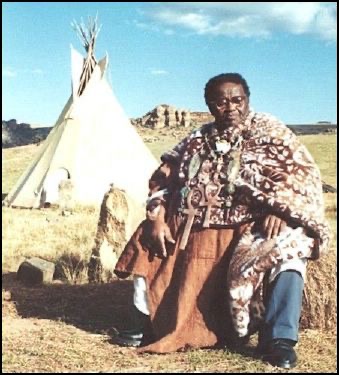
Credo Mutwa, Rustlers Valley
The man whose book had given me the story of Princess Marimba came to Marimba House on the day of the Grand Planetary Alignment, May 5th 2000, when Mercury, Venus, Mars, Jupiter and Saturn gathered with the Sun and Moon within a 26 degree arc of the sky. He stood inside the structure that bore the name from his own book and initiated what had been built. He came once. That was enough. We had his blessing and considered the space initiated as a space of prayer for peace.
Rustlers Valley had not always been a place of ceremony.
It had been an asparagus farm combined as a cherry farm, a piece of Free State mountain land that Frik Grobbelaar had worked in the ordinary way until the market made clear that farming in that remote valley was not going to sustain him. Three hundred and fifty kilometres from any major city, the Maluti Mountains were spectacular and impractical in equal measure. So Frik changed his strategy. He decided, as he put it, “to farm people”.
He built some huts around the farmhouse and began inviting people with alternative mindsets to spend weekends in the valley. Word spread the way word spreads in alternative communities, person to person, workshop to workshop, festival to festival. Within a few years Rustlers Valley had become one of South Africa’s most sought-after Festival sites and holistic venues, a place where massage practitioners and permaculture teachers and sound healers and sweat lodge facilitators and drummers and dancers all came to offer their work to people willing to make the journey. Four festivals a year drew thousands of people to experience the mountain festival.
Marimba House sat within this world and apart from it. It was my private venue space on the farm, built by my hands and the hands of the village men and women, on land I had no title to, through an arrangement with Frik that worked because it worked for both of us. I operated independently. When I was holding drumming weekends, Sound Journeys, Vision quests or San Pedro/Ayahuasca ceremonies I occupied the whole space. At other times Marimba House became available to the broader Rustlers Valley calendar, adding something the main venue could not offer, a raw, acoustic, ceremonial room with earth floors and a smoke hole.
My ability to hold sweat lodge and to make and tend ceremonial fires was valuable to the guest lodge operation. It was a mutual collaboration. I brought the ceremonial knowledge and the venue. Frik brought the infrastructure and the reach. It simply worked.
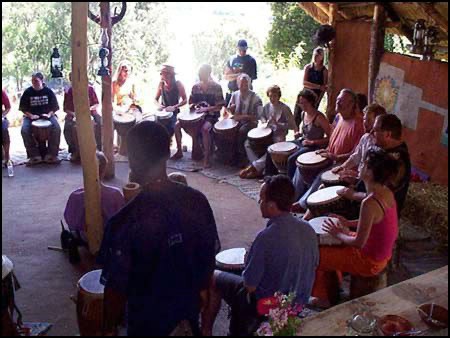
Drum workshop, Marimba House, Rustlers Valley

Lena Schlagmülder, drum circle
One of the first people to fill Marimba House with the sound it had been built for was a talented percussionist named Lena Schlagmülder.
She was an American drummer who had travelled to Ghana and worked with the Ghana Dance Ensemble, one of West Africa’s great repositories of traditional drumming knowledge. She came to Rustlers Valley, found the round mud room in the mountains, and understood immediately what it was for. She arranged an introduction to Emmanuel Gomada, a master drummer from the Ensemble, and the first workshop was set. We had 38 people who attended and it was a huge success, a first of its kind in South Africa. Drum circles had been held before, but never before had someone brought West African drum masters to teach thirty or forty people together over four days. Many who came learned how to run circles of their own, people with money bought more drums and held bigger circles, and it grew fast into a very big enterprise. It all stemmed from those workshops at Rustlers Valley.
The financing I worked out myself. I took deposits from people wanting to attend the four-day workshop and used those deposits to buy the air tickets for the drummers flying from Ghana. There was no safety net. If the drummers had not arrived I would have had nothing to offer back. The whole arrangement rested on trust, in Lena, in Gomada, in the participants who paid before anything was confirmed, in the basic faith that what needed to happen would happen. It held. Every time. I never had to refund a single deposit.
Gomada arrived. Thirty to forty people gathered in the round room and the space outside it, djembes between their knees. Four days of rhythm, four days of bass frequencies moving through mud walls and earth floors and mountain thatch. I held the bass drum. The foundation note. The pulse that everything else moved against. We ran those workshops four times a year, and the room absorbed each one and held the memory of it in its walls.

Marimba House interior
Nicholas Korte came later through a different route. He had heard about Gomada’s visits and contacted me directly. He was known as Africa, a name that suited him, a rogue drummer whose playing carried something untamed. We held five or six good workshops together before the corporations discovered that drum circles could be packaged and sold to companies as team-building exercises and began paying him city rates in Johannesburg. He went. I understood why.

Nicholas Korte, “Africa”
I watched this happen in every area of my work across those years. The sweat lodge became a corporate retreat. The sound journey became a wellness product. The sacred dance became a ticketed festival event. The plant medicine ceremonies became expensive retreats for people with money and no preparation. Each time the outer form was lifted cleanly away from the inner purpose and sold at scale. What the corporations took was only the sounds. The point was never available for purchase.
Nestor Kornblum and Michele Averard came from Spain in 2000, the year Marimba House was completed. Nestor had been born in Johannesburg and had left at twenty, eventually building one of Europe’s most significant sound healing practices together with Michele. They came back to South Africa and found their way to Marimba House after hearing about the space from people in Johannesburg who had visited.
Nestor and I played didgeridoo together. Two instruments, two men, the drones overlapping and the overtones rising into the thatch. Nestor taught me overtone chanting and how to apply it to the didgeridoo, the practice of producing multiple simultaneous tones with the human voice, a technique rooted in Tibetan and Mongolian tradition that he had spent years mastering. Michele’s voice filled the room.
Those sessions shaped the way I hold a Sound Journey. Two practitioners in a room together, finding out what harmonies they could create.

Jean White Eagle and John Pearson
Jean White Eagle and John Pearson came from the United States, holders of a sacred dance tradition called “For the One”, conducted in acoustically designed round dance arbors. They also worked with sound in a unique way and were linking together a global network of “Sound Chambers”. They recognised Marimba House as one of those spaces without being told what it was and included us in their global network. I was also the Drum Chief for their sacred dances held at Rustlers Valley. They came and held ceremony in a room built, without any knowledge of their tradition, along exactly the same principles their tradition was based on.
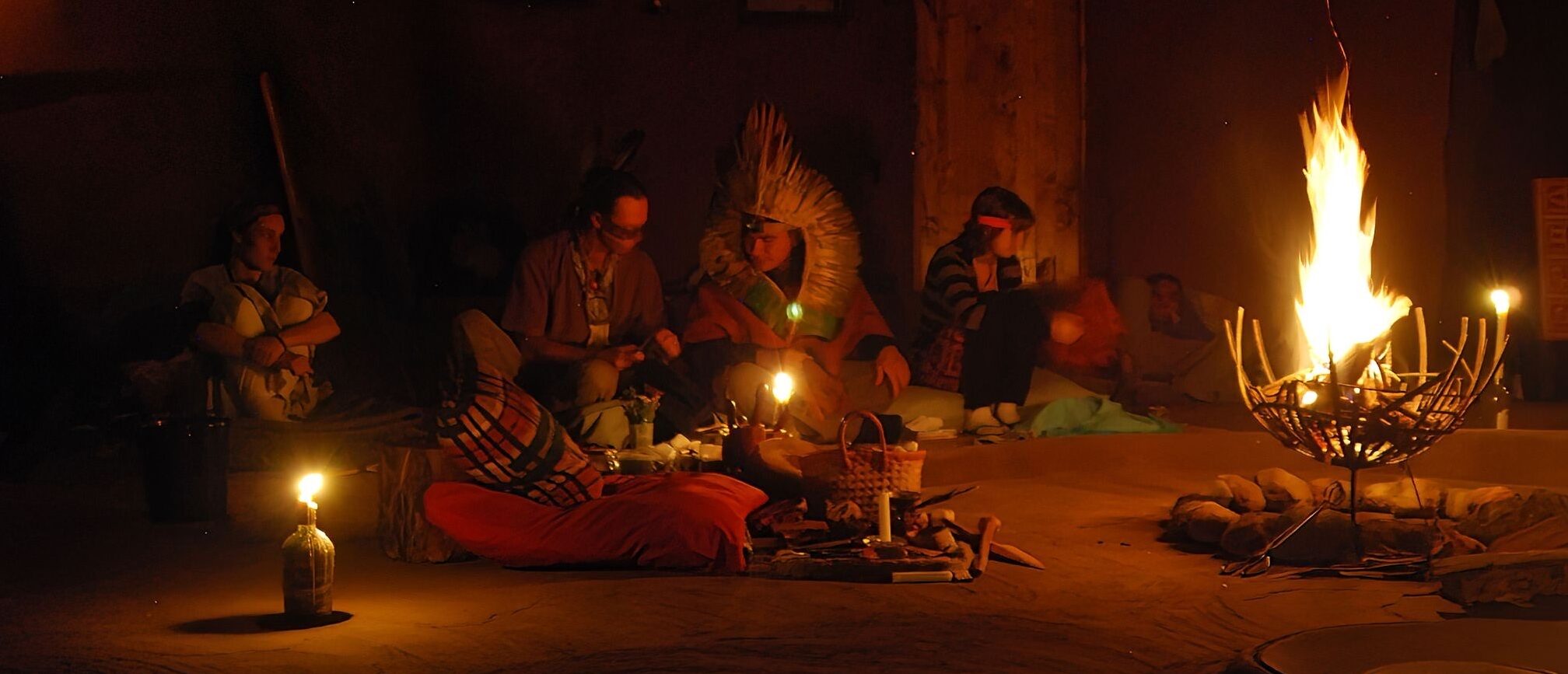
Night ceremony, Marimba House
The world kept arriving. Terence McKenna came, the ethnobotanist and philosopher. Bill Mollison came, the father of permaculture. Dr Luis Eduardo Luna came, who had already facilitated ayahuasca ceremony at Rustlers Valley with me as firekeeper. Davide Tomsů came and taught me a lot, a European musician who had built a band called “Shamanzi” from the instruments and inspiration Southern Africa gave him, and we played a great deal of music together, asking the same questions about life. Kholeho Mosala came, a great Marimba player from Cape Town who led a band called Asazi, and I played didgeridoo beside him in this band, “Asazi”, the word that would come to name my entire journey.

Davide Tomsů, of Shamanzi

Kholeho Mosala
All of this moved through Marimba House, a round room made of mud and cow dung, mountain grass and old car windows.
Nine years of life. 1998 to September 2007.
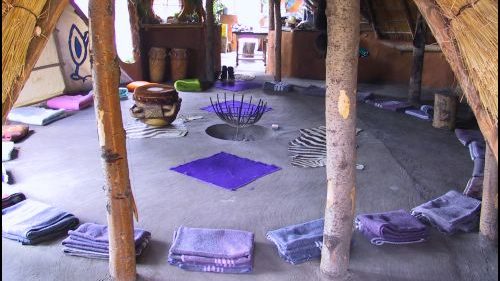
Marimba House set for ceremony, opening circle
In September 2007 we were ten days into ceremony.
Twelve people had come from Florianópolis in Brazil, members of the Santo Daime tradition, including Enio Staub and Beth Morera. We gathered every third day, the rhythm building and releasing and building again. We took the ceremonies into the caves in the valley, sitting around fire in the belly of the mountain, the rock walls holding the sound.
When the ten days were complete we drove to Johannesburg, my partner, Leanne, and myself, with the Brazilian crew, for one final ceremony before they flew home. It was a good ceremony. We slept.
The next day, back at Rustlers Valley, everyone was getting ready for the Save Rustlers Party. Sean Phillips was going to play. Someone had been smoking the beehives at the start of the driveway, and in very dry conditions the wind picked up and blew the fire over the entire Rustlers Valley Guest Lodge in about 45 seconds, burning everything in its path.
In the afternoon the message came.
We were three and a half hours away.

The fire, Rustlers Valley
We drove. Halfway back, a second message arrived. The fire had reached our house. It was burning. No more information was possible. The smoke in the valley was too thick to see through.
We arrived at ten o’clock at night.

The remains of Marimba House, September 2007
Marimba House was a smoldering ruin. Everything was gone. The round mud walls, the wattle frame, the poplar poles carried up the mountain trip by trip in the Kombi. The old car windows pushed into the earth without frames were melted. Ten to twelve thousand bundles of thatch, cut by village women from the road verges over months of careful work. The A-frame facing the valley. The small huts where guests had slept. The kitchen.
The fire had not stopped at Marimba House. It burned the entire Rustlers Valley Guest Lodge, its restaurants and kitchens, guest houses and workshop areas, and four or five private houses along the side of the mountain. Nine years of building and ceremony, reduced to ash.

What remained
We walked through what remained.

Starseed, the new ceremonial space we were just completing, had survived the fire
The Sweat Lodge and the Starseed ceremonial space were still standing. We had built them below the garden to hold the larger circles that Marimba House had become too small for, and they were newly built when the fire came. The ground around the Sweat Lodge had been cleared of grass, and that made a kind of boundary. The fire moved around the Starseed building.

Starseed and the Sweat Lodge, left standing
That was where we slept.
I lay on the ground in the Starseed space and listened to the fire still crackling in the mountains around us.
By morning I understood something I had not understood the night before. I had spent years building Marimba House and years filling it, pouring into it everything I knew about sound and ceremony and what a space needs to hold in order to hold people. I had thought the work lived in the structure. That the room was the container.
The spring ran on. The drumming knowledge Emmanuel Gomada brought from Ghana, and the drumming Nicholas Korte brought after him, were in the hands of everyone who had sat in that circle. My friendship with Davide and Kholeho. The overtone chanting Nestor had taught me was in my throat. The understanding Michele’s voice had opened in those mud walls was in every Sound Journey I would facilitate from that morning forward. Jean White Eagle’s sacred dances had been danced and could not be unlearned. The plants had done their work and that work was complete and continuing in the people who had received it.
Marimba House was just a container.
It was an invitation to recreate.
In the years that followed I rebuilt around the structure that never burned. The compound of huts, kitchen and toilets that grew up around it became known as Sunmoon Lodge; the ceremonial space around the new fire kept the name Starseed. I built new guest accommodation closer to Starseed, arranged around the surviving ceremonial space. The centre of focus shifted down the hill. The area where Marimba House had stood returned slowly to mountain.
We continued to do what we were doing around the new core.
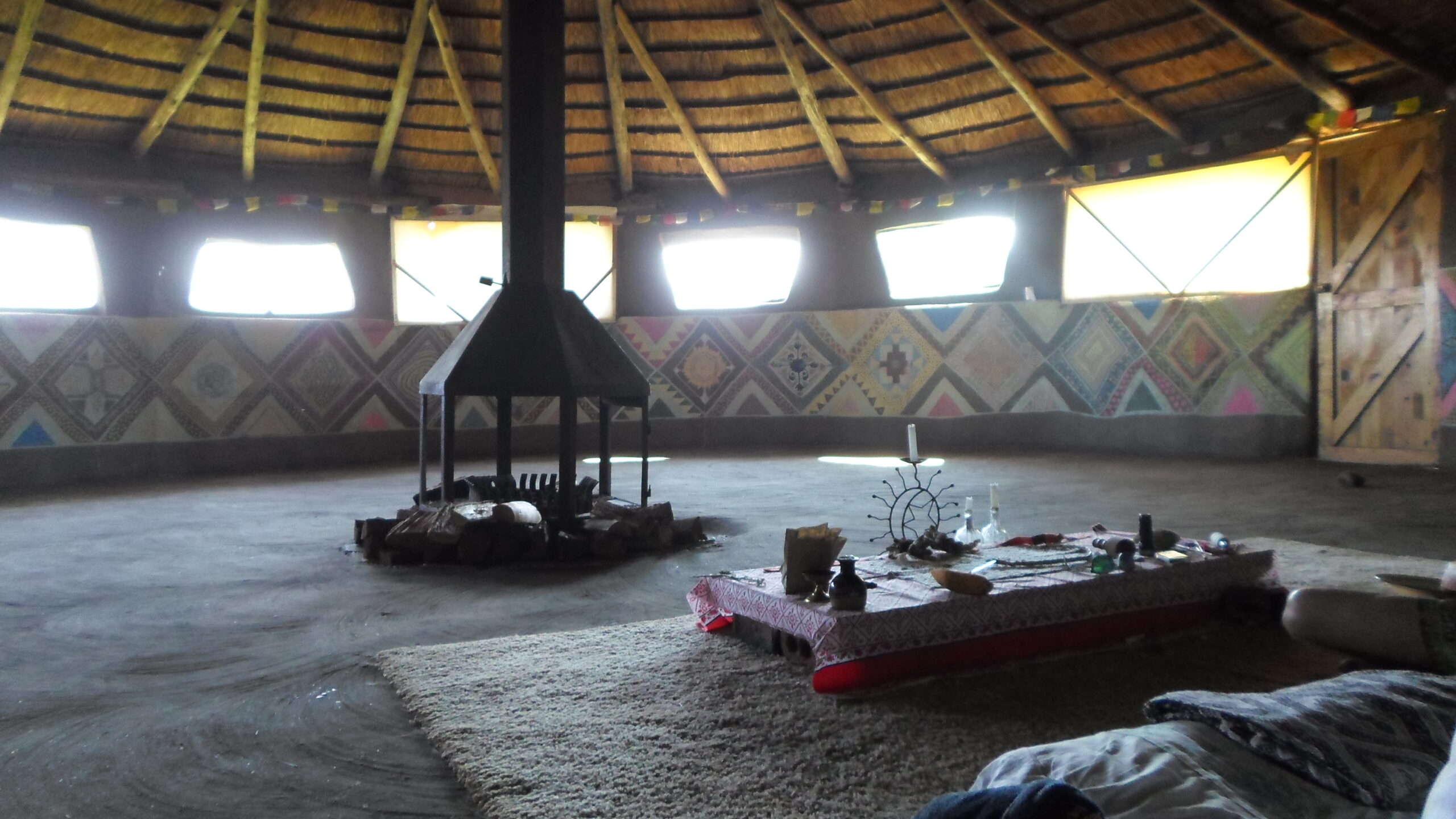
Starseed
Coming soon is the story of Sunmoon Lodge and Starseed, and the ceremonies and gatherings that were held there until 2014.
Writing these stories takes time. If they mean something to you, you can support my writing here.