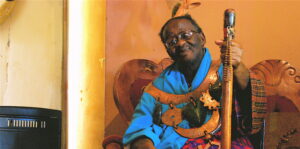
In the late nineties, around 1998, I was living at Rustlers Valley. I had been having health problems, a parasite of some kind, and I was seeking guidance.
Not far from where I lived was a place known as Sangoma Valley, where Sangomas came for their initiation, a place of power in the landscape that drew traditional healers from across the region. It was there that I met a man named Henrik, an initiated Sangoma who was practicing in the valley. I went to him for help with my health. He threw the bones to diagnose my condition, and I watched as the pieces landed across the mat. Then one bone rolled off the edge and fell to the ground. He looked up at me with surprise.
“Your one ancestor doesn’t know you,” he said.
I asked what I should do.
“You must go to the grave,” he said. “And say prayers to your ancestors.”
Henrik also did some herbal cleansing baths with me, and the parasite cleared up soon after. That gave me more trust in him.

Sangoma Valley · Rustlers Valley
I went back to my family and asked where the graves were. There were none. All of my grandparents had been cremated. I returned to Henrik and told him. He said, then find the ashes. Make your prayers to the ashes. I went back to my family and asked where the ashes were. No one knew.
We thought about this together, Henrik and I. And it was then that I realised something I had not fully reckoned with before. The grandfather I had grown up with was not my true grandfather. My true grandfather, David Stirling, had died in Scotland before I was born. There was no grave I could visit in South Africa. There were no ashes anyone could find.
“Uh-huh,” said Henrik. “This is the problem. You need to go to Scotland. To the grave.”
I was flabbergasted. I was living in a tipi. I had no money for an air ticket to Scotland.
Then I met Karolina. My beautiful wife. We married in 1998 and travelled to Scandinavia together, and that journey gave me the opening I needed. We hired a camper van and made our way to Scotland.
I had a serious eye infection at the time. We had travelled up to Findhorn first, to do some ceremonies there, and by the time we turned south toward Edinburgh my eyes were in a terrible state. We had two reasons to pass through Bathgate, the small town near Edinburgh where my grandfather was buried. I needed a doctor for my eyes, and I needed to find David Stirling.
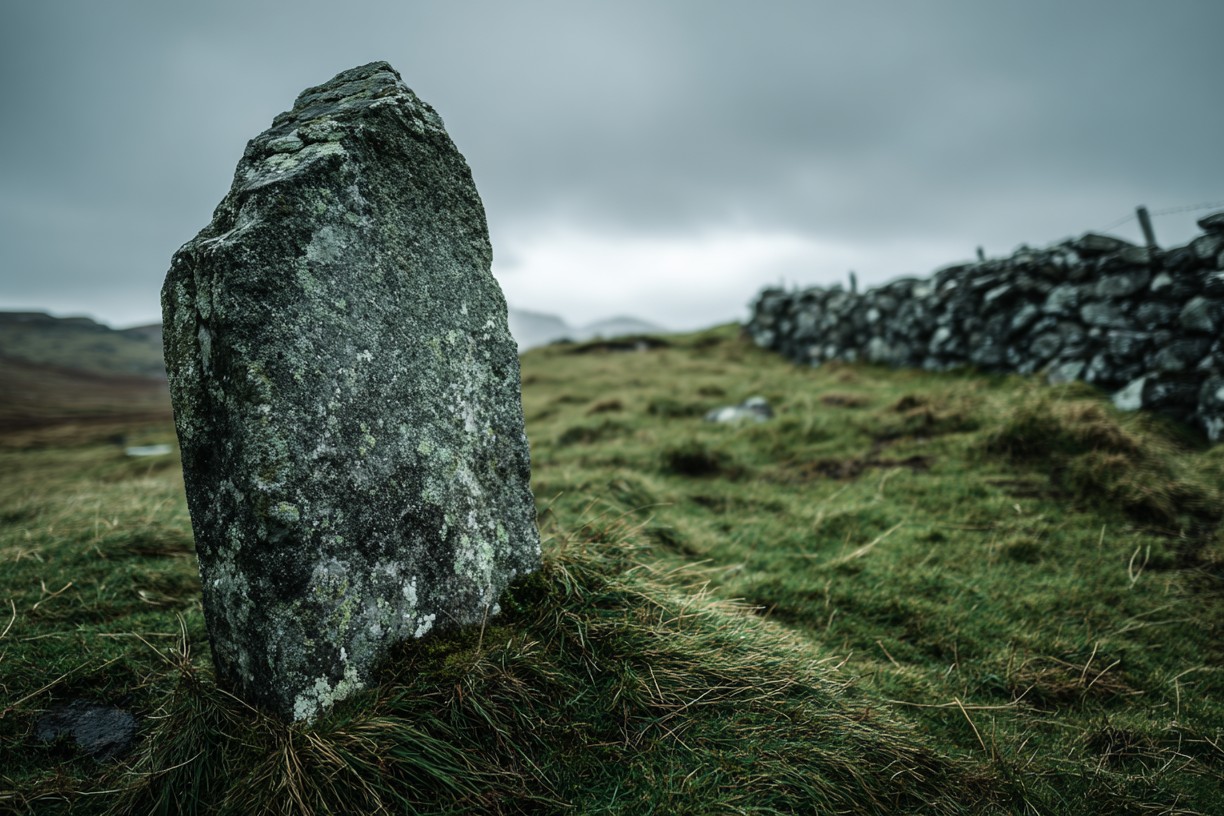
Bathgate, West Lothian
We stopped in Bathgate and walked into the first funeral home we found. The people there were remarkably helpful. They looked through their records and directed us to the most likely graveyard. When we arrived, the gentleman who looked after the records pulled down old dusty books and searched through the names until he found my grandfather’s entry. Then he looked up and said the grave was not here, it was at another site across town, and that he would take us there himself.
In the car he told me gently not to be disappointed if the gravestone was damaged or missing altogether. It was old. These things happened.
When we arrived at the second graveyard he guided me up a hill to a stone. He stopped and looked at it with some surprise. There was a new stone here, he said. He explained that some families paid a fee to have the stone replaced after a certain number of years. My grandmother, Mary Stirling, had recently arranged for it to be renewed.
I made my way to the grave.
My eyes were almost swollen shut. I could barely see. But I could read the words on the stone clearly enough.
Here lies David Stirling. A beautiful memory left behind.

Symbol of Peace
And carved into the stone at the top of the gravestone was a dove with a twig in its mouth. The ancient symbol of peace.
The Sangomas at Rustlers Valley had given me a name, Khotso, the Sesotho word for peace. They gave it to me before I was initiated. When I played the drum or the didgeridoo, the trance it created would carry the Sangomas into an altered state, and they believed I had some kind of magical power when I played. Standing at that grave, half-blind, in a cold Scottish graveyard, I saw that dove of peace. The ancestors of my culture, the Scottish coal miners, the Vikings before them, had not been spoken to in generations. The door between the living and the dead in my bloodline had been closed for a very long time. I was reawakening something, bringing a spark back to the ancestors of my own people.
I sat down in front of the stone and introduced myself to David Stirling for the first time. I told him who I was. I told him why I had come. I played my didgeridoo. I played my drum. I sang to him.
Then I picked up a small stone from the grave site, put it in my pocket, and we left.
We drove into Edinburgh with a paper map and no plan, only the knowledge that it was a large city and that I needed a doctor. We followed our intuition through the streets, weaving through a university car park near Edinburgh Castle, until we found a parking space and stepped out of the van. When we looked up, directly above the entrance in front of us was a large painted eye. The sign for the university eye department.

Edinburgh · 1998
I was taken in immediately. After several hours of tests, the doctors told me I needed to return once a day for a full week, and that if the infection had progressed much further I could have lost my vision entirely. We parked the camper van on the esplanade and lived there for the week.
The university eye department never charged me a single cent. Not for the consultations, not for the medication, not for the week of daily treatments. Nothing. We arrived as strangers with a paper map and a van, and we were taken care of completely.
That was how I first found my grandfather, standing half-blind on a hill in Scotland with a drum, a didgeridoo, and a stone I carried home in my pocket. The initiation in Zululand came a few years later, but the door had already been opened in Bathgate, and everything that followed moved differently.
Writing these stories takes time. If they mean something to you, you can support my writing here.
Continue the Journey