In 1993, after my first sweat lodge on the slopes of Table Mountain, Warrick did a card reading for me with the Lakota Sweat Lodge cards. I tell the story of that evening in The Name in the Heat. I had no frame of reference. I did not know what a sweat lodge was, I did not know what a card reading was, and I did not know what the Red Road was.
The cooler bag of beers and meat I had brought sat outside the lodge the entire time, unopened. I knew I had brought the wrong things to the wrong place.
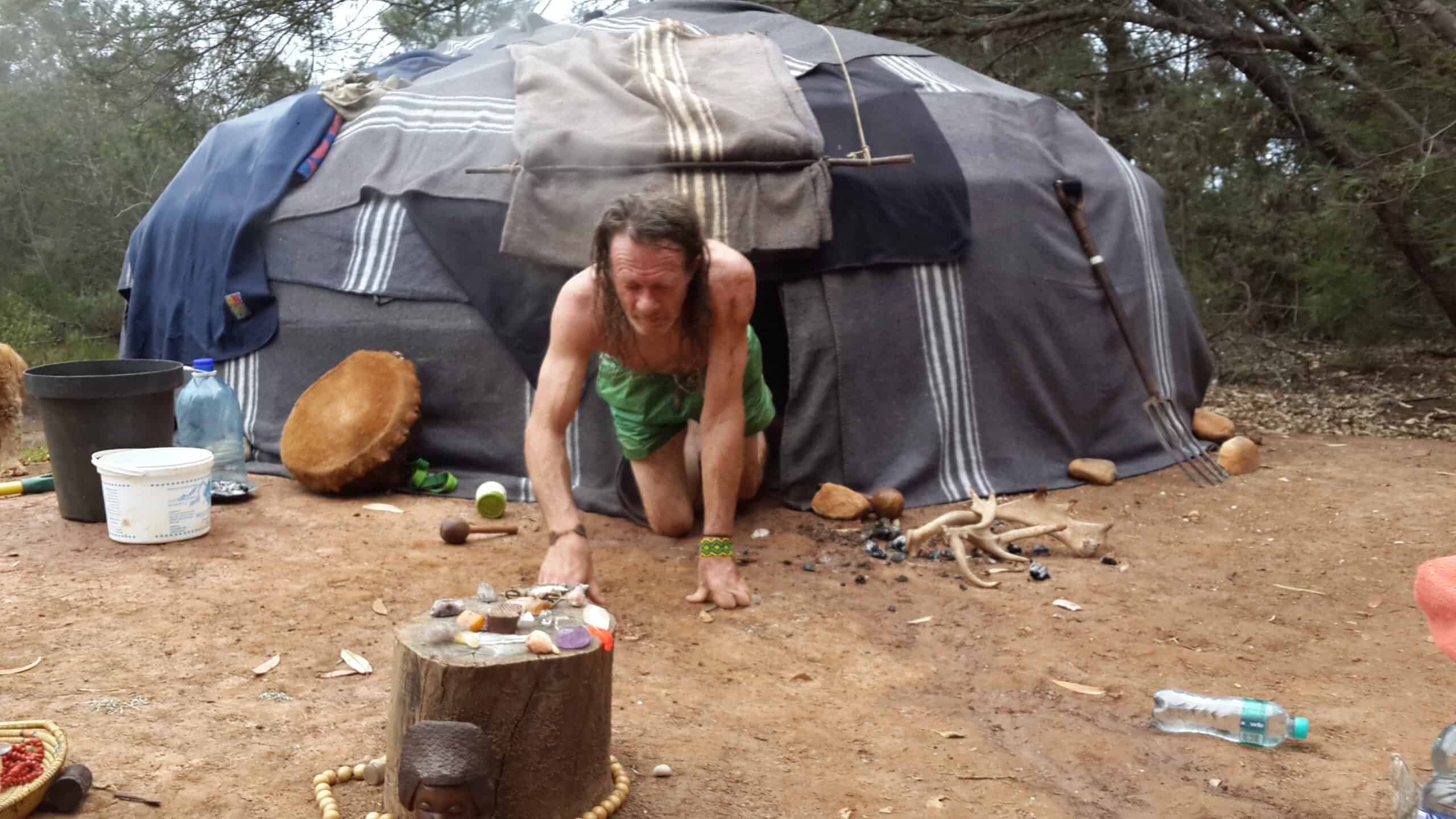
Niyan exiting the sweat hut
Warrick was a gentle soul with a gentle voice. He laid the cards out quietly and drew four cards. The meanings that follow are from the Lakota Sweat Lodge cards.
The first was Niyan. Card thirteen. The Spirit of Man. The Higher Self. The part of you that knows it is of the Creator, that knows it is eternal, that navigates through experience without ever being lost, even when you are certain you are lost. Warrick gave me that name, Niyan, and I carried it for seventeen years.
The second card was Pita. Fire. Eternal Life. The Lakota tradition teaches that fire is the great power of Wakan Tanka, the Creator, and that as one of the four elemental spirits, it can never be extinguished. The card asks: What will you leave behind? What light will you carry into the world, and what will remain when you are gone? Your words and actions are pieces of yourself that will be passed down to your children.
I had no children then, and my studio had just burned down.
The third card was Skan. Motion. Manifestation. The eternal Now of Creation, that which existed before time itself. Through Skan, you are given the gifts of experience, reflection, and hope. All that is created is in motion. The seas, the clouds, the trees, everything that lives upon the earth moves in a dance to the radiance of the One who created all things. You have the ability to use your inner power to attract what you want. Not by forcing, but by allowing.
The fourth card was Tob Tob. The Eight Directions of the Wind. Self-protection. The wisdom of change. Your life is like no other life. Your needs are like no other needs. Know what to change, how to change, into what to change.

The Red Road, the path we walk in the physical world
In the Native American teaching, when we walk on the earth, we walk the Red Road. When we walk the path of the spirit world, we walk the Blue Road. Together they are the sacred circle of life and death: the Red Road on the earth, the Blue Road in the spirit world, and then back to the Red Road.

The Blue Road and the Red Road
I did not know any of this on that mountain in 1993. I know it now because I walked it. The sweat lodge I came to that evening with my cooler bag was the first of many, built across South Africa, Brazil and Costa Rica. When Tim Sekeya came from the Lakota nation to Rustlers Valley in 1997, I became his firekeeper and learned what the fire actually is.

Ahpo Wi Chapi · Card 33 · The Morning Star · Hope
The fifth card came to me later. It was not drawn that evening, but the relevance of what is on that card to my reading has been important to me. Ahpo Wi Chapi. Card thirty-three. The Morning Star. Hope. A light that shines at the boundary between darkness and light, the last star visible before the dawn.
On Sunday, 2 February 2003, my son was born on the grass outside a sweat lodge at Rustlers Valley. It was four in the morning, and as he arrived, Venus rose in the sky above the mountain. The Morning Star.
The local Sesotho people named him Mphatlalatsane on the day of his birth, their word for the Morning Star. They did not know about a card reading on Table Mountain ten years earlier, or about Ahpo Wi Chapi, or the Lakota tradition, or a man named Warrick who had laid four cards out in the mountain air.
Pita had asked me, back in 1993, what I would leave behind for my children. I did not have an answer then. But I think I know the answer now.
Writing these stories takes time. If they mean something to you, you can support my writing here.

