I had been told that it was the mother of all psychedelics and that it was an experience beyond any other. I had no idea what I was getting into.
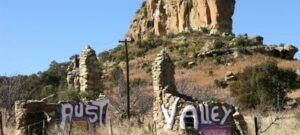
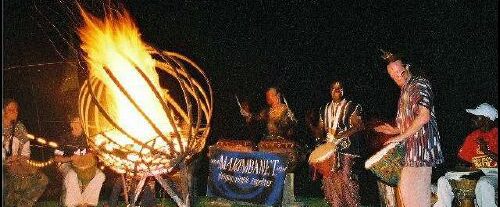
My first experiences were in 1996. I was living in a tipi in the foothills of the Maluti Mountains in central Southern Africa, and my life revolved around the tipi. I had been experimenting with the use of psychedelics in combination with shamanic rituals such as trance drumming circles, vision quests, fasting dances, sweat lodges, and other healing ceremonies. Things most people had never heard of at the time.
We were working with San Pedro cactus and fresh psilocybin mushrooms. It was life at the edge, and my wish was to be there, at the edge, where no one had been before, where there is creation and destruction in the same vision. I had been experiencing so many new truths recently that I was very interested in this mysterious plant medicine. So, I was in.
We were not yet connected to the internet, so there was very little information available to us other than what we had heard. I did not research until well after my first three experiences.
The very first ceremony was in a dimly lit restaurant, because there was no other space to do it. The facilitator served everyone a cup of the brew, which tasted vile, fermented and rank. The only vision I saw was my vomit. I spent most of the night with my head and/or my backside in the toilet. Never puked and defecated so much in my life. The same week, I sat in a tipi with five other people, but there was not enough medicine to bring the visions, and we all just had a pleasant night around the fire, feeling no real experience. It was nearly a year later, in 1997, that the third time came, with a big group of about 25 people. The medicine was potent, everyone had a profound experience, and this was the night everything changed.
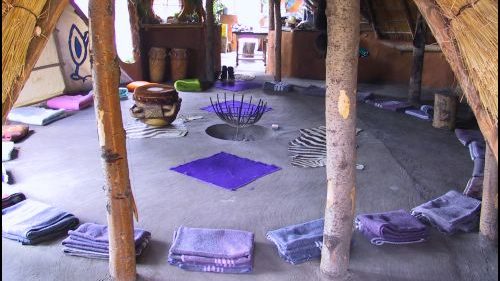
Opening circle, preparing for ceremony in the Maluti Mountains
We drank around the fire after holding a Sweat Lodge, with the tipi close by as a shelter. There were people from all walks of life, an incredible group who had heard about this ceremony. The medicine was potent, and everyone in the group had a profound experience.
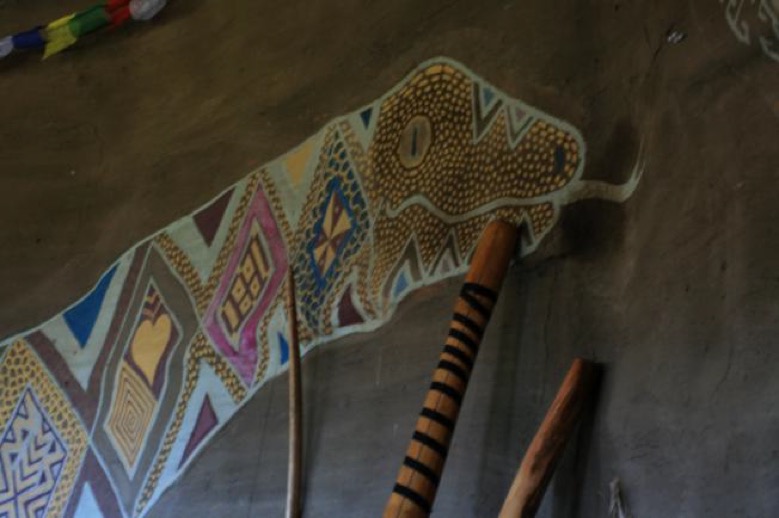
I experienced the most fantastic world of geometric patterns and shapes. I climbed up the tapestry of life and saw the power of creation. The patterns I experienced were something I had never seen before. Later, I was to discover that the patterns I had seen were the Shipibo designs. I was not aware of this at the time, but I later came across Shipibo patterns that were identical to the ones I had experienced.
This is important because it showed me how relevant the songs are in a ceremony and how they influence the visions. I had never seen or explored the Shipibo culture, but the songs being played around the fire that night were Shipibo Icaros sung by various curanderos, and they seemed to evoke the exact patterns I experienced.
I can clearly say that this was a turning point in my life. Things were never the same again. I had seen an astral reality and countless beings that I had never before perceived or even knew existed. The animals, the geometric patterns, the incredible colours, the earth alive and breathing, the moon singing and the clouds dancing. It was indescribable.
After that night, I worked with Dr Luis Eduardo Luna, a Colombian anthropologist who was holding seminars and visited South Africa six times between 1997 and 2004. These gatherings were the first of their kind in South Africa, and a few hundred South Africans were fortunate enough to attend and learn from the plant.

Sunmoon Lodge, Rustlers Valley, the cactus gardens
In 1999, I began building Marimba House, a ceremonial space on the slopes of the mountain, specifically for ceremonies, and we continued to hold a series of ceremonies there every year. We planted Caapi vines and purple berry bushes and started to grow seedlings. We raised thousands of the purple berry bush and distributed it to many growing centres around South Africa.
I had planted over a thousand San Pedro plants around my home and along the slopes of the mountain. All of these plants should still be happy and healthy where I left them, and I trust that they have benefited many people since I departed from the home and ceremonial healing centre I built there.
“This sparked a chain reaction in the communities of South Africa, and a new culture began to emerge around the use of sacred plants.”
“I wanted to know more. And so the journey continued.”
Writing these stories takes time. If they mean something to you, you can support my writing here.