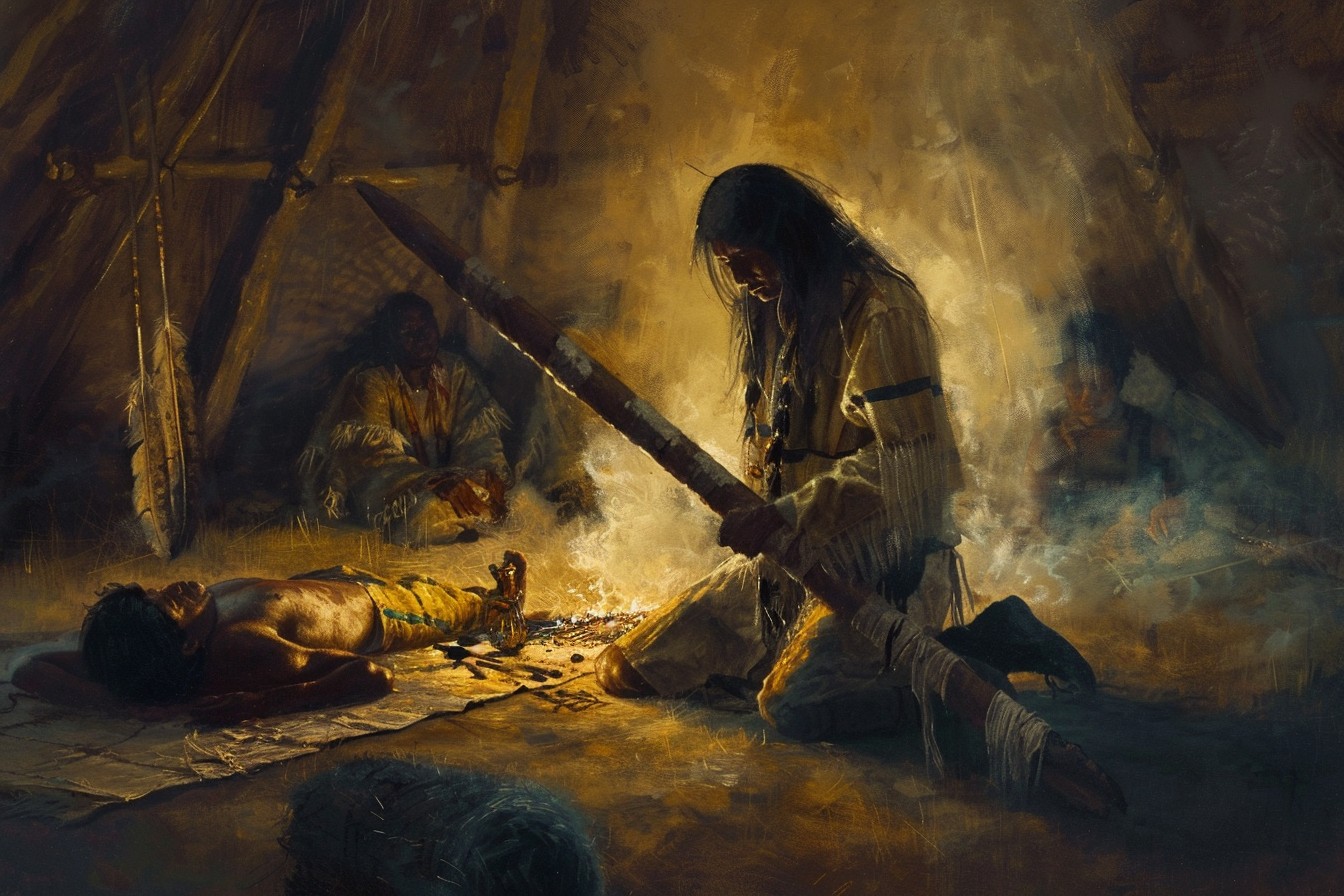
The first sound journey happened in a cave, around a fire, in the dark, with someone holding a drum and a specific intention, to move a person from one state of being to another using sound as the vehicle.
That is where it began. Everything else is a later development.
Every culture that has survived long enough to leave a record has used sound as medicine. In Egypt, priests chanted in temples to restore harmony to the body and the spirit. In Greece, Hippocrates incorporated music into his understanding of healing. In Australia, where Aboriginal culture reaches back tens of thousands of years, the didgeridoo has carried Yolngu ceremonial knowledge for at least fifteen hundred years, the age of the oldest rock art that shows it, its drone used to clear energy blockages and open pathways for healing. Tibetan monks developed the capacity to sing multiple simultaneous tones, producing frequencies that moved through the body in ways that ordinary speech cannot reach. Mongolian and Tuvan singers mastered overtone chanting in the high Central Asian steppes, a practice rooted in the understanding that the human voice, properly used, is the most sophisticated sound healing instrument available.
In southern Africa, the sangoma tradition placed sound at the centre of both diagnosis and healing. The drum was the voice of the ancestors. The healer’s song was the thread connecting the visible world to the invisible one. Sound was how ceremony worked.
Traditional cultures worldwide understood drumming as a technology for moving between states of consciousness. The rhythmic pulse of the drum, sustained at the right frequency, carries the practitioner and the participant into altered states where healing work becomes possible. The brain responds to rhythmic sound by synchronising its own electrical activity to the frequency it receives, moving from the ordinary waking state of beta into the slower frequencies of alpha and theta, the territory of deep relaxation, creative insight, and access to levels of experience not available in ordinary consciousness.
The instruments were always specific to their purpose. The didgeridoo produces a drone rich in overtones, frequencies layered on frequencies, that moves through the body as well as the ears. The singing bowl, whether Himalayan bronze or quartz crystal, sustains a tone that the body absorbs and responds to at a cellular level. The gong produces a wash of complex sound that overwhelms the analytical mind and opens the deeper layers beneath it. These were understood, across many cultures and many centuries, as tools. Precise, refined, effective tools for a specific purpose.
The purpose was always transformation, and the sounds were always the vehicle.
The modern Western history of sound healing begins in earnest in the mid-twentieth century, when a handful of researchers and practitioners began translating ancient understanding into contemporary forms.
Hans Jenny, a Swiss scientist working in the 1960s, developed the field he called Cymatics, the study of how sound organises matter. His experiments showed that sound frequencies applied to physical substances, sand, water, powder, created complex geometric patterns, the same patterns that appear in nature, in snowflakes, in cellular structures, in the forms of living organisms. Sound, Jenny demonstrated, organises and shapes.
Alfred Tomatis developed what became known as the Tomatis Method, using modified sound and music to stimulate the auditory system, with measurable effects on cognitive development, emotional regulation, and learning. His work established that the ear is an active participant in how the nervous system organises itself.
Don Conreaux, drawing on his study of Kundalini yoga, spent decades developing the gong as a healing instrument and teaching what became known as the gong bath, a term that describes being immersed in sound the way a body is immersed in water. The gong baths that now fill yoga studios and wellness centres around the world owe a great deal to his work.
Jonathan Goldman founded the Sound Healers Association in Lexington, Massachusetts, in 1982, one of the first formal organisations dedicated to the therapeutic use of sound. His research drew on both the ancient traditions and the emerging scientific understanding of how frequency affects the body, and he spent decades building a framework that could be taught, transmitted, and applied.
Mitchell Gaynor was an oncologist, a cancer specialist at the Strang-Cornell Cancer Prevention Center in New York, who began using sound as a complementary therapy with his patients in 1991. Chanting, music, quartz crystal bowls, used alongside conventional treatment, with results he found remarkable. He published Sounds of Healing in 1999, a book written by a physician about the science of how sound and vibration affect us at a physiological level. A medical doctor using singing bowls with cancer patients was a significant moment of legitimisation for the field.
The crystal singing bowl itself came from the semiconductor industry. In the 1980s, high-precision quartz glass bowls were used to grow silicon chips. Someone noticed the sounds they made. It is industrial technology, born in a laboratory only a few decades ago, carrying a ceremonial language far older than itself.
The Himalayan singing bowl has its own story of misattribution. There is no hard evidence that what the Western wellness world calls a Tibetan singing bowl is ancient, or that it is Tibetan. Scholarship on Tibetan ritual music lists many instruments, and singing bowls are not among them. The earliest written record of them in the West is a 1972 album called Tibetan Bells, and their popularity surged in the early 1990s, in the same years that Western interest in Tibet was growing.
The djembe carries a version of the same story, though here the misattribution is about how it is played. The drum itself is genuinely old, invented by the Mandé people of West Africa, centred in the Mali Empire, and carried outward through Guinea, Senegal, Côte d’Ivoire, and Burkina Faso as that empire’s influence spread. The tradition around it was strict and structured. A djembe ensemble was two drummers and a bell player, in service to a single dancer, who controlled the rhythm through movement rather than the other way around. Reaching the djembe itself took years. A player began on the bell, and only after long apprenticeship under a master was permitted to move inward toward the lead drum. What is now called a drum circle, strangers gathering with mismatched djembes to improvise together in a community hall or a festival field, has no ancestor in that tradition. The drum is old. The circle is new, a Western form inspired by something ancestral.
This is the pattern worth naming plainly. The instruments are ancient. The bowl, the drum, the gong, these are real objects with real histories reaching back centuries or further. What is often invented is the claim of an unbroken lineage of use. The ninety-minute lying-down sound bath and the open community drum circle are contemporary forms, inspired by ancestral practice and shaped for a different time and a different audience. The ancestors are real. The specific container being sold as theirs is usually new.
The vastness of ritual space.
By the late 1990s, everything was in place for the commodification of sound healing.
The yoga studio had become the primary vector. Crystal bowls played during savasana, the final resting pose at the end of a yoga class, introduced millions of people to the experience of lying still in a room full of sound and finding that something happened. Students who experienced it began training as facilitators. The sound journey, or sound bath, emerged as a standalone commercial offering, a ticketed one to two hour event in its own right, requiring no ceremony, no preparation, no spiritual lineage, and no previous experience of anything except lying on a mat.
The wellness industry recognised it immediately. Sound healing fitted perfectly into the expanding definition of wellness, which had moved beyond physical health into mental, emotional, and spiritual wellbeing, a market worth billions of dollars and growing. By the 2010s the sound bath had crossed from yoga studios into hotel spas, corporate conference rooms, performing arts centres, and festival stages. Facilitators trained over weekends and began offering sessions within months. Apps offered binaural beats and singing bowl recordings for home use. The ancient understanding that sound is a vehicle for transformation became a product available for purchase at any level of investment, from a nine dollar monthly subscription to a five thousand dollar retreat.
The form remained. The container was gone.
What moved from the ceremonial practice into the commercial one was the aesthetic experience, the pleasant sensation of lying in a room full of resonant sound and feeling the nervous system settle. That experience is real. It has measurable physiological effects, reduced cortisol, slower brainwaves, genuine relaxation.
The original practice was transformation. The difference between a sound bath and a sound journey is the difference between a warm shower and a river crossing. One leaves you clean and comfortable. The other changes where you are.
While the commercial wave was building through the late 1990s and early 2000s, a different current was running.
In Spain, Michele Averard and Nestor Kornblum, founders of the International Association of Sound Therapy, were developing a practice rooted in overtone chanting, voice work, and the understanding of sound as a genuinely transformative ceremonial force. Nestor, who had been born in Johannesburg and left South Africa at twenty, had mastered what very few Westerners have achieved, the deep voice overtone chanting used by Tibetan monks and Tuvan singers. Michele’s practice combined sound therapy with her training in energy work, reflexology, and craniosacral therapy. Together they built a training programme they called the Sound Journey, a specific term for a specific practice, the use of voice, acoustic instruments, and intentional ceremony to move participants through physical, emotional, mental, and spiritual dimensions of experience.

The mountain and Marimba House
In the Maluti Mountains of South Africa’s Free State, three hundred and fifty kilometres from any major city, something else was being built at the same time. A round room made of mud and cow dung and mountain grass and old car windows pushed into earth walls without frames, supplied by a cold spring rising from the rock beneath the floor. I was building it with a chainsaw and a Volkswagen Kombi, with no money and no title to the land, because I understood, from Paul Henderson’s didgeridoo and a tree on Table Mountain, that the practice needed a home worthy of what it was.
That story, Marimba House, is told elsewhere in these pages.
What matters here is that Nestor and Michele came to that mud room in the year 2000 and played didgeridoo and sang overtones into walls that had been built for exactly that purpose. Two practitioners working independently on opposite sides of the planet, building the same understanding from different directions, meeting in the mountains of the Free State and finding that the room held what they brought without effort, because it had been built to hold it.
The Sound Journey as a living practice, rooted in ceremony, in lineage, in the understanding that sound is a vehicle and the destination is transformation, was being shaped in those exchanges, in a mud room in the mountains, around fires in caves, in the spaces between people who understood what they were doing and why.
The sound bath is now everywhere. On any weekend in any city with a yoga studio you can lie on a mat for ninety minutes and be washed in crystal bowls and gong tones and leave feeling better than when you arrived. That is a real service and the people offering it are frequently sincere and sometimes skilled.

Lying still while something moves inside
The Sound Journey is rarer. It requires a practitioner who understands that the sounds are the vehicle. Who knows how to hold a ceremonial space, which is a specific and learnable skill that takes years to develop and cannot be acquired in a weekend. Who has enough experience of genuine transformation, their own and other people’s, to recognise the difference between relaxation and change, and to work with that difference intentionally.
The ancient practitioners who sat in caves and drummed people into altered states were offering passage. The drum carried you somewhere, and the skill of the one holding the drum was in knowing where to take you and how to bring you back.
That is what a Sound Journey is. That is what it has always been.
The sounds are the vehicle. What happens in the spaces between them is the journey.
You can read how this lineage found its way to me in my own story, The Sounds Are Not the Point, or read Marimba House, the story of the mud room in the Maluti Mountains where this practice took root, or explore the handcrafted instruments that carry it forward today.
Writing these stories takes time. If they mean something to you, you can support my writing here.